
DNA Breakthrough Reveals Anglo-Saxon Brother and Sister Double Burial
Ancient DNA work has revealed a major new breakthrough in the investigation of the Anglo-Saxon double burial discovered by Time Team and Operation Nightingale at Cherington, featured in the recent Time Team Special - Return to The Princely Burial: The Sword in the Stones.
New ancient DNA analysis, carried out by the Francis Crick Institute, has confirmed that the two young people buried together in the grave – a young boy and a teenage girl buried beside him – were brother and sister and may have died at the same time, from fast acting infectious disease.
Top Banner Image © Neil Max Emmanuel / Time Team
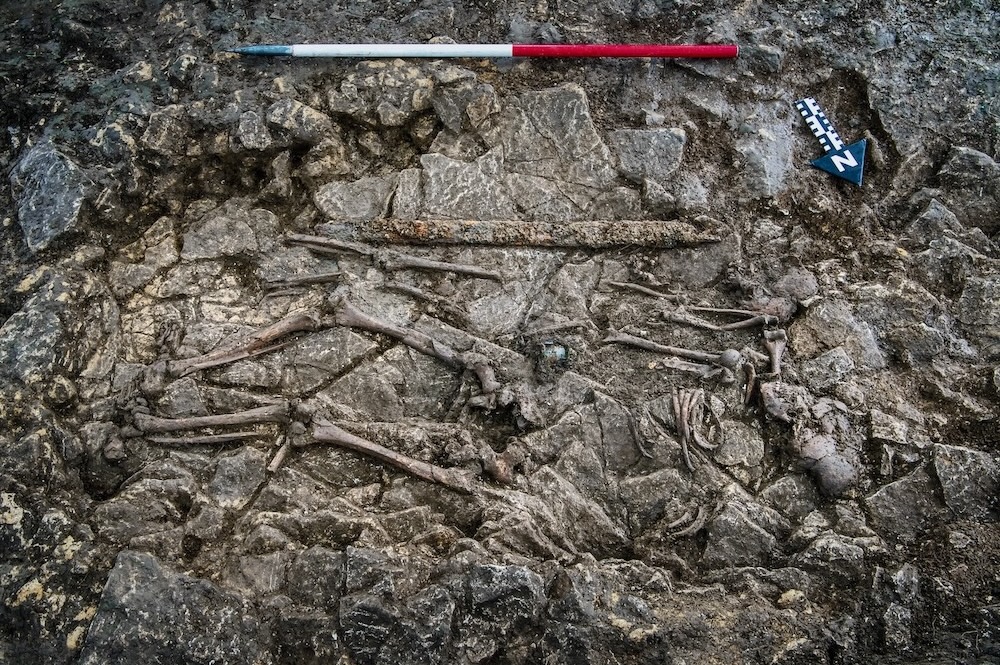

Photo © Harvey Mills / Time Team
The grave was first excavated by a Team, including Osteo-archaeologist Jacqueline McKinley, during Time Team’s revisit to Cherington. It immediately stood out because of the unusual way the pair had been laid to rest. The small boy was positioned holding a sword, while the girl had been placed facing towards him and raised slightly, as if watching over him. This intimate tableau, was designed to be seen by those mourning the deaths. It most likely mimicked a scenario played out in life, with an elder sister overseeing the wellbeing of a precious younger brother.
Double burials are relatively unusual in Anglo-Saxon cemeteries. They can often signify graves with two bodies buried at different times. To have a confirmed familial link between bodies buried at the same time in a grave is extremely rare.
Jacqueline McKinley has said:
“When I’ve seen double burials before, people who are buried together at the same time, they are quite often buried side by side. The boy was laid down and the young teenage girl was laid down next to him. She was turned to face him and I thought she was kind of propped up. To get two of them buried at the same time - this suggests that they both died of probably some kind of infectious disease at the same time and the fact that she was put in there together with him, still in that sort of caring position overlooking him, overseeing him, suggests to me that she may well have caught this infection from him while looking after him, as his big sister.”
Dr. Helen Geake, Time Team archaeologist and Anglo-Saxon specialist, suggested that the results fundamentally change how archaeologists can interpret double burials.
She said, “Our stories were told on not being able to know, and now we can know, in at least some cases. It opens up a whole new vista”. She went on to say… “immediately your thoughts go to the wider family and what an awful tragedy this must have been to lose two children at the same time so that the funeral was one event.”
The revelation also raises wider questions about family relationships and households in Anglo-Saxon England. Further research on other Anglo-Saxon cemeteries is already suggesting that burial practices varied considerably between communities, even on sites only a few miles apart.

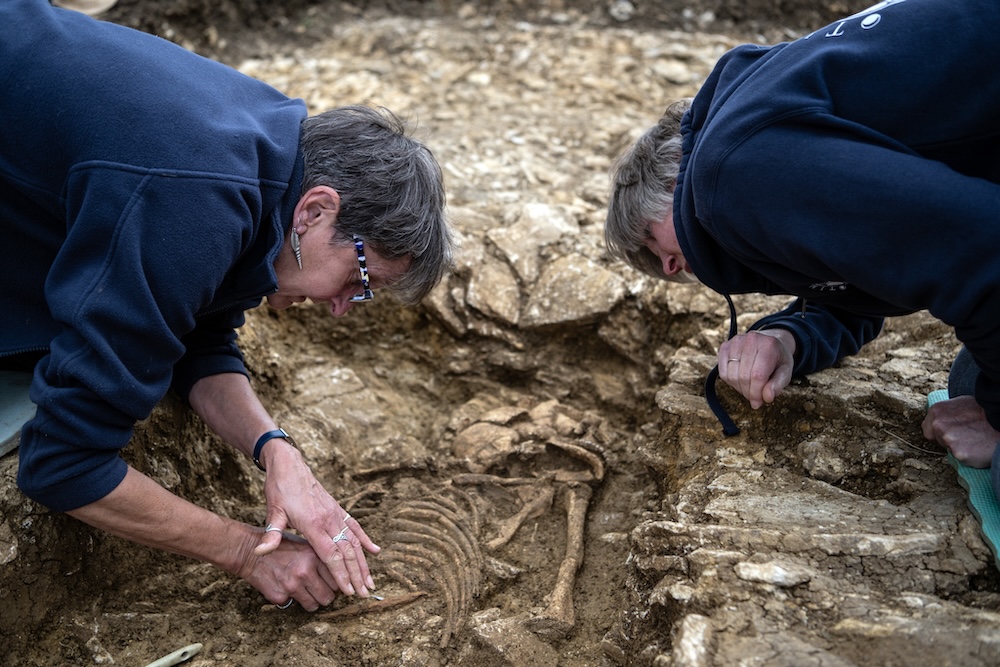
Photo © Harvey Mills / Time Team
Richard Osgood MBE, Senior Archaeologist for the M.O.D. and Operation Nightingale, said, “I was fascinated to hear this incredible news - the results show how important scientific advances have been for archaeology. The Operation Nightingale work with Cotswold and Time Team has revealed an astonishing, if tragic family story.”
Operation Nightingale is a military initiative developed to use archaeology as a means of aiding the recovery of service personnel injured in recent conflict.
Tim Taylor MBE, Creator of Time Team Digital, said:
“Across more than 250 Time Team excavations, there have always been a few where incredible evidence from a critical period of the past, has come together with a remarkable human story. The Princely Burial for me is one of the most memorable”
The Princely Burial Excavations
Archaeologists were alerted to the site in Gloucestershire, in 2016, after a chance discovery of an Anglo-Saxon sword by a local metal detectorist. Subsequent archaeological excavations by Operation Nightingale, revealed that the sword came from the grave of a young boy, aged around 8 or 9 years old, who had been buried in the 6th Century as a warrior, with a full-size sword, two spears, rare glassware and a shield. This discovery was soon dubbed ‘The Princely Burial’, and was considered of national importance.
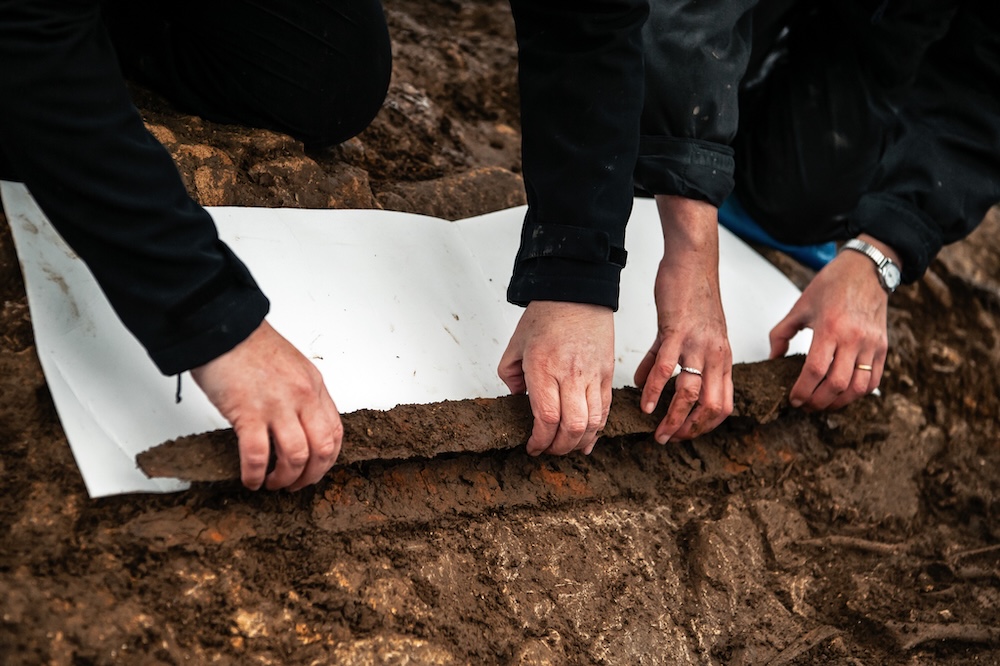


Photo © Harvey Mills / Time Team
Discovery of the Double Grave - the 3rd Excavation on the site.
In July 2024, archaeologists from the Time Team television programme and the M.O.D.’s Veteran initiative, ‘Operation Nightingale’, supported by Cotswold Archaeology, discovered that the cemetery extended further into the field. The discovery of a second sword at the very last minute, led to the Team’s return in September 2024.
Painstaking excavation of this second sword, overseen by Conservator, the late Pieta Greaves of Drakon Heritage, led to the discovery that it was buried with another small boy aged around 7 or 8 years old and his sister. To have 2 child warrior burials in one such close proximity is truly remarkable.
That story is told in Return to the Princely Burial, released in January 2026. The full episode is now available on YouTube:
For Time Team press enquiries, interview requests and further images, contact: press@timeteamdigital.com